How Visual Documentation Wins Construction Delay Claims: A Canadian Contractor's Guide
February 10, 2026
Three-quarters of construction professionals will deal with a schedule-related dispute at some point in their career. When those disputes escalate to formal claims — adjudication, arbitration, or litigation — the outcome almost always comes down to one question: what actually happened on-site, and when?
The contractor who can answer that question with objective, timestamped evidence wins. The one relying on memory, email chains, and after-the-fact reconstructions loses.
Here is how continuous visual documentation from construction cameras is changing the way Canadian contractors prove delay claims — and how to set yourself up so the evidence is there when you need it.
The Three Burdens of Proof in Construction Delay Claims
Every construction delay claim in Canada requires the claimant to prove three things. Miss any one of them and the claim fails.
1. Causation — What Caused the Delay?
You must prove that a specific event or condition — not something within your control — caused the schedule to slip. Weather events, design changes, unforeseen site conditions, late material deliveries, or interference by the owner or other trades.
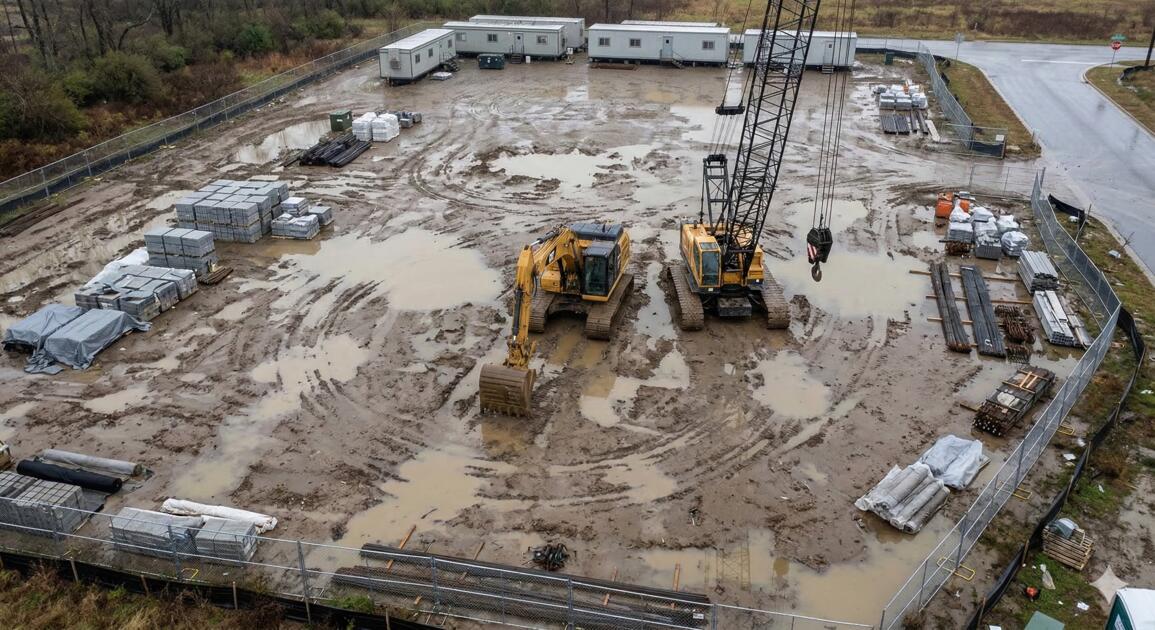
Camera footage showing standing water on a foundation for 10 days after an unprecedented storm, or an empty site for two weeks while waiting for revised drawings, proves causation in a way that written descriptions cannot match.
2. Entitlement — Are You Entitled to Relief?
You must prove that the delay event falls within a category that your contract recognizes as grounds for a time extension or compensation. Most construction contracts distinguish between excusable delays (weather, force majeure), compensable delays (owner-caused), and non-excusable delays (contractor-caused).
Visual evidence helps establish entitlement by showing that the delay was not within the contractor’s control. Timelapse footage of a site sitting idle because the owner had not completed their enabling works — with the contractor’s equipment mobilized and ready — is powerful evidence of a compensable delay.
3. Quantification — How Much Did It Cost?
You must prove the duration of the delay and the resulting financial impact. This is where most claims fall apart. Without precise documentation of when work stopped and when it resumed, quantifying the delay period becomes a battle of competing narratives.
Camera footage with timestamps removes ambiguity. You can show exactly which days the site was active, which days it was idle, and when work resumed. Paired with cost records, this creates a clear link between the delay period and the financial damages claimed.
Why Traditional Documentation Falls Short
Most contractors document delays the same way they have for decades: daily logs, superintendent reports, and periodic photographs. Here is why that approach is increasingly inadequate for formal claims.
Daily Logs Are Subjective
A superintendent’s daily log reflects what one person observed and chose to write down. Logs are written at the end of a long day, from memory, and they inevitably focus on what the superintendent thought was important at the time. Details that become critical months later — the exact day a crane was idle, when materials arrived, when a specific area was cleared — may not have been recorded.
Photos Are Selective and Sporadic
Manual site photographs are taken when someone decides to take them. They cover what the photographer pointed the camera at. They miss everything else. And when a claim is filed eight months later, the photos that would have proven the point often do not exist.
Reconstructing Timelines After the Fact Is Weak Evidence
When lawyers and claims consultants try to reconstruct a delay timeline months after the events, they piece together emails, meeting minutes, invoices, and delivery receipts. This reconstructed timeline is inherently weaker than contemporaneous evidence — evidence that was created automatically, at the time the events occurred.
Adjudicators and arbitrators know the difference. A reconstructed timeline tells them what someone believes happened. Timestamped camera footage shows them what actually happened.
How Camera Footage Strengthens Each Element of a Delay Claim
Proving Weather Delays
Weather delays are among the most common — and most disputed — types of construction delays. The contract typically defines what constitutes “abnormal” weather, and the contractor must prove that actual conditions exceeded that threshold.
Camera footage provides a continuous visual record of site conditions. Rain, snow, standing water, frozen ground, high winds — all visible in the footage, all timestamped. When paired with Environment Canada weather data, this visual record is difficult to dispute.
Compare this to a daily log entry that says “heavy rain, no work today.” That log entry might be accurate, but it provides no objective proof. The camera footage does.
Documenting Owner-Caused Delays
When the owner fails to provide access, deliver owner-furnished equipment, complete enabling works, or respond to RFIs in a timely manner, the contractor is entitled to a time extension and potentially compensation.
Camera footage showing a mobilized crew and equipment sitting idle on-site — with no activity in the area where the owner’s work was supposed to be completed — provides compelling evidence of an owner-caused delay. This is particularly valuable because it shows that the contractor was ready and willing to proceed.
Proving Concurrent Work and Mitigation Efforts
A strong delay claim does not just show that work stopped. It shows that the contractor took reasonable steps to mitigate the impact — working in other areas, resequencing activities, bringing in additional resources.
Timelapse footage showing activity continuing in unaffected areas of the site while the delayed area sits idle demonstrates mitigation. This evidence supports both the claim for the delayed work and the contractor’s credibility.
Establishing Precise Delay Duration
The most contentious element of most delay claims is duration. The owner says the delay was three weeks. The contractor says it was six. Without objective evidence, this becomes a negotiation rather than a determination of fact.
Camera footage settles the question. Review the footage, identify the date work stopped in the affected area, identify the date it resumed, and count the days. The timestamps are embedded in the footage automatically — they are not someone’s estimate.
Organizing Camera Documentation for Legal Proceedings
Having footage is one thing. Presenting it effectively in adjudication or arbitration is another. Here are best practices for making your visual evidence work in a formal proceeding.
Create a Visual Timeline
Pull key frames from your camera footage to create a chronological visual timeline of the delay event. Show the site condition before the delay, during the delay, and after work resumed. Date-stamp each frame clearly. This visual timeline becomes a powerful exhibit that adjudicators can understand at a glance.
Pair Footage with Written Records
Visual evidence is strongest when it corroborates written records. Your progress reports say work was suspended on March 12. Your camera footage shows no activity in the affected area starting March 12. Your daily log notes the reason. Together, these three sources create a documentation package that is very difficult to challenge.
Preserve Original Metadata
Never edit or crop camera footage submitted as evidence. Present the original files with their embedded metadata — date, time, camera ID, location. Edited footage, even if the edits are innocent (cropping, colour correction), can be challenged as tampered evidence.
Maintain Chain of Custody Documentation
Document how the footage was stored, who had access, and how it was retrieved for the proceeding. Cloud-based camera platforms that maintain automatic access logs satisfy chain of custody requirements without any additional effort from the contractor.
The Financial Case for Camera Documentation
The ROI of construction cameras extends well beyond delay claims, but the claims angle alone justifies the investment.
Consider the numbers. A single delay claim on a mid-sized commercial project can involve hundreds of thousands of dollars in disputed costs. Legal fees for adjudication or arbitration start at $25,000 and frequently exceed $100,000. A construction camera system costs a fraction of that — and the documentation it produces applies to every claim scenario, not just the one you anticipated.
More importantly, strong documentation often prevents disputes from escalating to formal claims in the first place. When you can show the other party timestamped footage of exactly what happened, negotiations become productive rather than adversarial.
Setting Up Documentation Before Problems Arise
The most common mistake contractors make is installing cameras after a problem develops. By then, the critical early footage is already lost.
Install Cameras During Mobilization
Make camera installation part of your standard mobilization checklist. The footage captured during early site work — excavation, foundation, utility relocation — is often the most valuable because early-stage delays cascade through the entire project schedule. See our camera setup guide for a step-by-step walkthrough.
Cover All Critical Work Areas
A single camera on the main elevation captures overall progress, but delay claims often involve specific work zones. Position cameras to cover all areas where delay-sensitive work will occur — especially interfaces between trades and areas dependent on owner or third-party deliverables.
Use a Platform with Long-Term Storage
Delay claims are often filed months or years after the events occurred. Your camera platform must retain footage for the duration of the project and beyond. Sitelapse retains footage for 6 months to 2 years depending on your plan, with the option to archive critical footage indefinitely.
Enable Remote Access for Your Team
Your project manager, superintendent, and legal counsel should all be able to access footage remotely. When a potential delay event occurs, remote monitoring allows your team to review conditions in real-time and make informed decisions about mitigation — before the delay compounds.
Frequently Asked Questions
Is construction camera footage admissible in Canadian arbitration and adjudication?
Yes. Timestamped, metadata-embedded camera footage is treated as documentary evidence in Canadian arbitration and Ontario’s ODACC adjudication process. Because it is contemporaneous (created at the time of the events) and automated (not curated by a party), it carries significant evidentiary weight.
How far back can I retrieve footage for a delay claim?
This depends on your camera provider’s retention policy. Sitelapse plans include 6-month to 2-year retention, and critical footage can be archived indefinitely. For delay claim purposes, retention through project completion plus the applicable limitation period (typically two years in Ontario) is recommended.
Can the other party challenge the authenticity of camera footage?
They can raise the question, but it is difficult to successfully challenge footage with embedded metadata stored on a cloud platform with access logs. The automated nature of construction cameras — capturing frames at fixed intervals without human intervention — makes the footage inherently more credible than manually captured evidence.
Should I notify the other party that cameras are recording?
In most Canadian jurisdictions, recording in areas where there is no reasonable expectation of privacy — including construction sites — does not require consent. However, disclosing that cameras are operational is considered best practice and can deter problematic behaviour. Many contractors include camera disclosure in their site orientation packages.
Construction delay claims are won and lost on evidence. The contractors who invest in continuous, automated visual documentation before problems arise are the ones who can prove their case when it matters. The ones who rely on reconstructed timelines and scattered photos are fighting uphill.