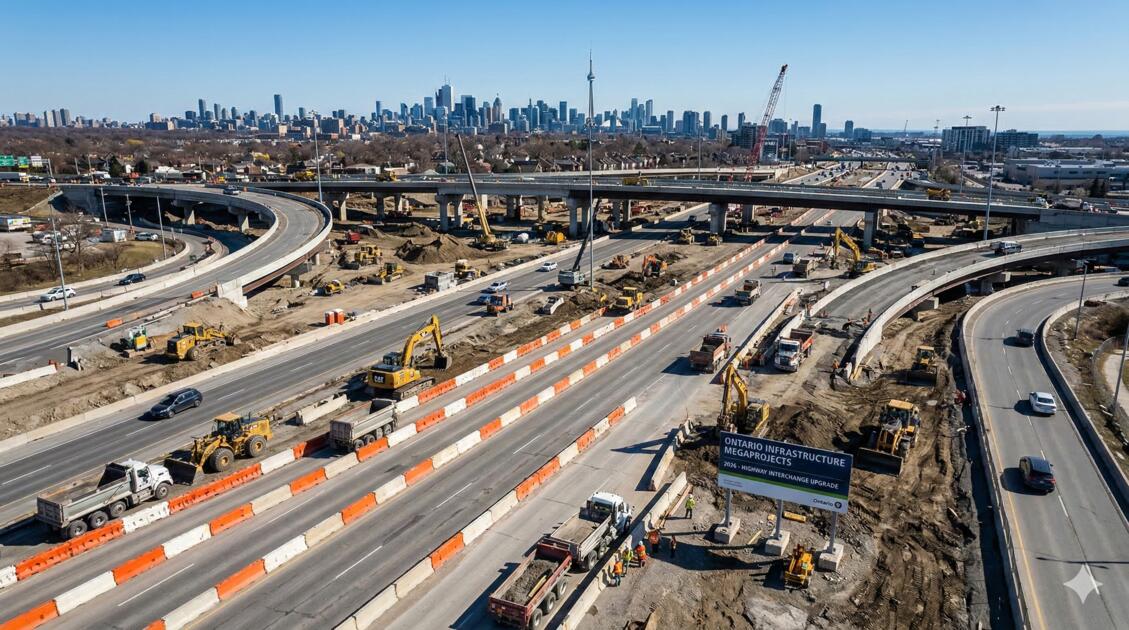
Ontario's $223 Billion Infrastructure Boom: Documenting Megaprojects from Highway 413 to the Ontario Line
November 25, 2025
Ontario’s 2025 budget made one thing unmistakably clear: the province is building at a scale it has never attempted before. With $223.1 billion committed to infrastructure over the next decade, Ontario is simultaneously constructing new highways, subway lines, hospitals, long-term care homes, and transit corridors across every region of the province.
The numbers are staggering, but numbers alone do not build public confidence, satisfy regulatory requirements, or protect general contractors from delay disputes worth tens of millions of dollars. What does is documentation — continuous, timestamped, and indisputable. For a broader view of how these projects fit into the national picture, see our overview of the top 10 construction projects in Canada 2026.
Here is what Ontario’s infrastructure boom means for construction documentation, and why timelapse cameras are becoming standard equipment on every major public project in the province.
The Scale of Ontario’s Infrastructure Commitment
$223.1 Billion Over 10 Years
The Ontario government’s 2025 budget allocates $223.1 billion in capital spending over the next decade, making it the largest infrastructure investment in the province’s history. This is not aspirational planning. Contracts have been awarded, tunnel boring machines are in the ground, and steel is being erected on sites across the Greater Golden Horseshoe and beyond.
To put that figure in perspective, Ontario’s annual infrastructure spending now exceeds the entire GDP of several Canadian provinces. The construction workforce needed to deliver this pipeline is estimated at over 100,000 workers at peak activity, spanning civil, transit, healthcare, and institutional sectors.
Where the Money Is Going
The allocation breaks down across several major categories, each with its own documentation demands.
Highways — $30 billion. Highway 413, the Bradford Bypass, the QEW Garden City Skyway replacement, Highway 7 widening, and dozens of interchange and bridge rehabilitation projects across the 400-series network.
Transit — $61 billion. The Ontario Line ($27 billion), Scarborough Subway Extension ($5.5 billion), Yonge North Subway Extension ($5.6 billion), Eglinton Crosstown West Extension, GO Expansion electrification, and Hamilton LRT.
Hospitals and long-term care — $48 billion. New hospital builds in Mississauga, Brampton, Windsor, Niagara, and Ottawa, plus 58,000 new and redeveloped long-term care beds.
Schools, broadband, and municipal infrastructure. Thousands of individual projects that collectively represent billions in public spending.
Every dollar is public money. Every project faces oversight from multiple levels of government, media scrutiny, and community expectations. Documentation is not optional — it is a condition of doing business.
Highway Megaprojects: Highway 413, Bradford Bypass, and the QEW Skyway
Highway 413
Highway 413 is a 52-kilometre, 400-series highway connecting Highway 400 in Vaughan to Highway 401/407 near Milton. The project will cross through Peel, York, and Halton regions, involving major interchange construction, bridge building, and extensive earthwork through some of the fastest-growing communities in Canada.
The environmental and political scrutiny surrounding Highway 413 makes documentation particularly critical. Environmental compliance approvals impose strict conditions on habitat protection, stormwater management, and construction sequencing. Timelapse cameras positioned at key interchanges and environmentally sensitive crossings provide auditable evidence that these conditions are being met — or early warning when they are not.
For general contractors bidding on Highway 413 packages, demonstrating a documentation capability that satisfies both Infrastructure Ontario and the Ministry of the Environment is increasingly a differentiator in the procurement process.
Bradford Bypass
The Bradford Bypass is an 11-kilometre, four-lane expressway connecting Highway 400 and Highway 404 through the Town of Bradford West Gwillimbury and the Town of East Gwillimbury. Like Highway 413, the project involves crossing sensitive areas including the Holland Marsh and Lake Simcoe watershed.
Environmental monitoring requirements on the Bradford Bypass are among the most stringent in Ontario highway construction. Continuous visual documentation supplements the environmental monitoring program by providing a visual record of construction activity relative to buffer zones, seasonal restrictions, and erosion control measures.
QEW Garden City Skyway Replacement
The Garden City Skyway replacement in St. Catharines is a marquee project within the Niagara region. Replacing an aging elevated highway structure while maintaining traffic flow on one of Ontario’s busiest commercial corridors demands precise construction sequencing — and documentation to prove that traffic management plans were followed and milestones were achieved on schedule.
Transit Megaprojects: Ontario Line and Beyond
Ontario Line
The Ontario Line is the single largest transit project in Canadian history. At $27 billion, it will deliver 15.6 kilometres of new rail and 15 stations through some of Toronto’s densest neighbourhoods, connecting Exhibition Place to the Ontario Science Centre.
Construction is now active at multiple station sites, tunnel portals, and elevated guideway segments simultaneously. The project involves tunnel boring beneath active streets, station excavations adjacent to occupied buildings, and integration with existing TTC infrastructure at interchange stations.
For a project of this complexity, visual documentation serves multiple purposes. It satisfies Metrolinx and Infrastructure Ontario reporting requirements. It provides evidence for the inevitable delay and disruption claims that arise on multi-billion-dollar transit projects. And it gives the public — who are living through years of construction disruption — tangible proof that their transit system is being built.
Our detailed analysis of why Ontario infrastructure projects need timelapse cameras covers the legal and regulatory context in depth.
Scarborough Subway Extension
The Scarborough Subway Extension replaces the aging Line 3 (formerly the Scarborough RT) with a three-station extension of Line 2 into Scarborough Centre. The $5.5 billion project includes tunnelling, a new maintenance and storage facility, and complex integration work at Kennedy Station.
Community engagement has been a central concern throughout the project’s planning and early construction phases. Residents in the Kennedy Station area and along the tunnel alignment have legitimate concerns about construction impacts, traffic disruptions, and noise. Public-facing timelapse streams showing construction progress help maintain community support by demonstrating that the disruption is producing results.
Yonge North Subway Extension
The Yonge North Subway Extension carries the TTC’s Line 1 from Finch Station north to Richmond Hill Centre, adding five new stations and serving one of the GTA’s fastest-growing corridors. The $5.6 billion project will involve tunnelling under Highway 407, crossing Steeles Avenue, and building new stations in both Toronto and York Region — requiring coordination between two municipal jurisdictions and multiple layers of provincial oversight.
GO Expansion
Metrolinx’s $36.9 billion GO Expansion program is converting the commuter rail network into a frequent, electrified rapid transit system. The scope includes corridor electrification, new stations, grade separations, and signal upgrades at dozens of locations across the Greater Toronto and Hamilton Area.
With work happening simultaneously across the entire network, centralized visual monitoring through a timelapse camera platform allows program managers to track progress at every site without spending their days driving between construction zones. Our guide to construction progress reports and stakeholder communication outlines how to structure reporting for programs of this scale.
Documentation Requirements for Public Megaprojects
The Broader Public Sector Procurement Directive
Ontario’s Broader Public Sector (BPS) Procurement Directive governs how public entities acquire goods and services, including construction contracts. The directive requires accountability, transparency, and value for money — principles that have direct implications for project documentation.
Under the BPS Directive and associated record-keeping requirements, project documentation must be retained for a minimum of seven years after project completion. This includes progress records, correspondence, change orders, inspection reports, and — increasingly — visual documentation of construction activities.
For a highway project with a five-year construction timeline, that means documentation systems must produce records that remain accessible and intelligible for twelve years or more. Timelapse camera platforms that archive footage in cloud storage with organized, searchable timelines satisfy this requirement far more reliably than hard drives full of unsorted smartphone photos.
Infrastructure Ontario’s Project Agreement Requirements
Infrastructure Ontario’s Alternative Financing and Procurement (AFP) model, used on most major projects, imposes specific documentation and reporting obligations on private-sector project companies. Progress reports, photographic records, and milestone documentation are contractual requirements — not optional best practices.
Project companies that can demonstrate robust visual documentation systems gain an advantage during the procurement process. Evaluators look for teams that can provide transparent, verifiable reporting throughout multi-year construction periods.
Municipal Transparency and Public Accountability
Ontario municipalities are subject to the Municipal Freedom of Information and Protection of Privacy Act (MFIPPA). When municipalities fund or co-fund infrastructure projects, construction documentation becomes subject to freedom-of-information requests from residents, media, and advocacy groups.
Timelapse footage provides an unambiguous record that satisfies these requests efficiently. Rather than compiling hundreds of pages of written reports in response to an FOI request, a municipality can provide access to timestamped visual documentation that speaks for itself.
How Timelapse Cameras Help General Contractors
Winning Public Contracts
General contractors bidding on Ontario infrastructure work face increasingly sophisticated evaluation criteria. Technical proposals are scored on methodology, schedule, risk management, and — critically — reporting and documentation plans.
Including a timelapse camera deployment plan in a technical proposal signals several things to evaluators: the bidder understands the transparency expectations of public projects, the bidder has systems in place for automated reporting, and the bidder is prepared for the dispute resolution mechanisms that are standard on projects of this scale.
Managing Multi-Site Programs
A general contractor working on GO Expansion might have active work at five or six stations simultaneously. A highway contractor might be managing grading, structures, and paving operations across a 20-kilometre corridor.
Timelapse cameras at each work location feed into a centralized dashboard, giving project directors real-time visibility into progress across their entire program. This is not a luxury on megaprojects — it is an operational necessity. Daily site visits to every location are physically impossible when sites are spread across the GTA or across regions.
Dispute Protection
Construction disputes on public megaprojects are measured in millions, not thousands. Delay claims, differing site conditions, schedule acceleration demands, and deficiency holdbacks are standard features of large public contracts.
Under Ontario’s Construction Act, adjudication proceedings require rapid presentation of evidence. A contractor with continuous timelapse footage of their work can demonstrate exactly what was happening on any given day — weather conditions, equipment on site, workforce levels, and progress achieved. This evidence is objective, timestamped, and far more persuasive than conflicting witness statements composed months after the fact.
Labour and Equipment Verification
On large public contracts, owners and construction managers frequently require daily logs of workforce counts and equipment utilization. Timelapse footage provides an independent verification of these logs, protecting both the contractor (who can prove they mobilized as planned) and the owner (who can verify that reported resources were actually on site).
Community Engagement Through Visual Documentation
Building Public Support
Major infrastructure projects disrupt communities for years. Road closures, noise, dust, and traffic detours test public patience. Support erodes when residents cannot see progress — when all they experience is disruption without visible results.
Public-facing timelapse streams change this dynamic. A resident who can watch their neighbourhood’s new subway station take shape, week by week, maintains a connection to the project’s purpose. A business owner on a street affected by tunnel construction can see that the work is advancing, that the disruption has a timeline, and that the result will be worth the wait.
Council and Board Reporting
Municipal councillors, transit board members, and hospital board directors all need to report to their constituents on project progress. A 60-second timelapse video compressing six months of construction into a visual narrative is more effective than any slide deck. It communicates progress in a way that is immediate, intuitive, and shareable.
Several Ontario municipalities have begun embedding public timelapse feeds on their project websites, giving residents direct access to construction progress without filtering through official communications channels.
Media Relations
Construction projects make news — usually when something goes wrong. Having timelapse footage available gives project teams a proactive communication tool. Instead of responding to negative coverage with written statements, they can provide visual evidence of progress, proper sequencing, and safety compliance.
Media outlets are far more likely to use visual content than written press releases. A compelling timelapse clip showing a bridge being built or a tunnel boring machine advancing generates positive coverage that written updates simply cannot achieve.
What This Means for the Next Decade
Ontario’s $223.1 billion infrastructure commitment is not a single budget cycle — it is a decade-long building program. The projects currently in procurement or early construction will not be complete until the early to mid-2030s. New projects will enter the pipeline as existing ones are completed.
For the construction industry, this represents a sustained period of high activity with correspondingly high expectations for documentation, transparency, and accountability. The contractors, project managers, and public agencies that invest in automated visual documentation systems now will be better positioned to win work, manage risk, and maintain public confidence throughout this unprecedented building cycle.
The documentation standards being established on the Ontario Line, Highway 413, and GO Expansion today will become the baseline expectation for every public project in the province. Continuous timelapse coverage is no longer an innovation — it is becoming a requirement.
Frequently Asked Questions
Are timelapse cameras required on Ontario public infrastructure projects?
There is no single provincial regulation that mandates timelapse cameras specifically. However, Infrastructure Ontario’s project agreements, the Broader Public Sector Procurement Directive, and municipal transparency requirements collectively create documentation obligations that timelapse cameras satisfy more efficiently than any alternative. Many RFPs for major projects now include visual documentation as an evaluated component of technical proposals, making cameras a practical necessity for competitive bidding.
How long must construction documentation be retained on public projects?
Ontario’s record retention requirements vary by agency, but the Broader Public Sector Procurement Directive requires a minimum of seven years after project completion for procurement-related records. For projects with warranty periods, maintenance obligations, or potential litigation, practical retention periods can extend to ten years or longer. Cloud-based timelapse platforms with long-term archival storage make this retention straightforward and cost-effective.
Can timelapse footage be used as evidence in Construction Act adjudications?
Yes. Ontario’s Construction Act adjudication process accepts a wide range of evidence, and timestamped visual records are among the most persuasive forms of documentation available. Timelapse footage can establish site conditions on specific dates, demonstrate weather impacts, verify workforce and equipment presence, and document construction sequencing — all of which are common points of dispute in delay claims and payment adjudications.
How do timelapse cameras work on highway projects that span long corridors?
Highway projects typically require cameras at strategic locations rather than continuous coverage of the entire corridor. Key positions include major interchange construction sites, bridge and overpass locations, environmentally sensitive crossings, and areas with high public visibility. Solar-powered cellular cameras are particularly effective on highway projects because they can be deployed at remote locations without access to site power or internet infrastructure. As construction progresses along the corridor, cameras can be relocated to follow the active work front.
Get Started on Your Infrastructure Project
Ontario’s infrastructure boom is creating unprecedented demand for professional construction documentation. Whether you are a general contractor bidding on Highway 413, a project company delivering the Ontario Line, or a municipal government overseeing a local infrastructure project, timelapse cameras provide the documentation, transparency, and accountability that public projects demand.
Get a quote for your infrastructure project and see how Sitelapse can support your next megaproject with continuous visual documentation from day one.