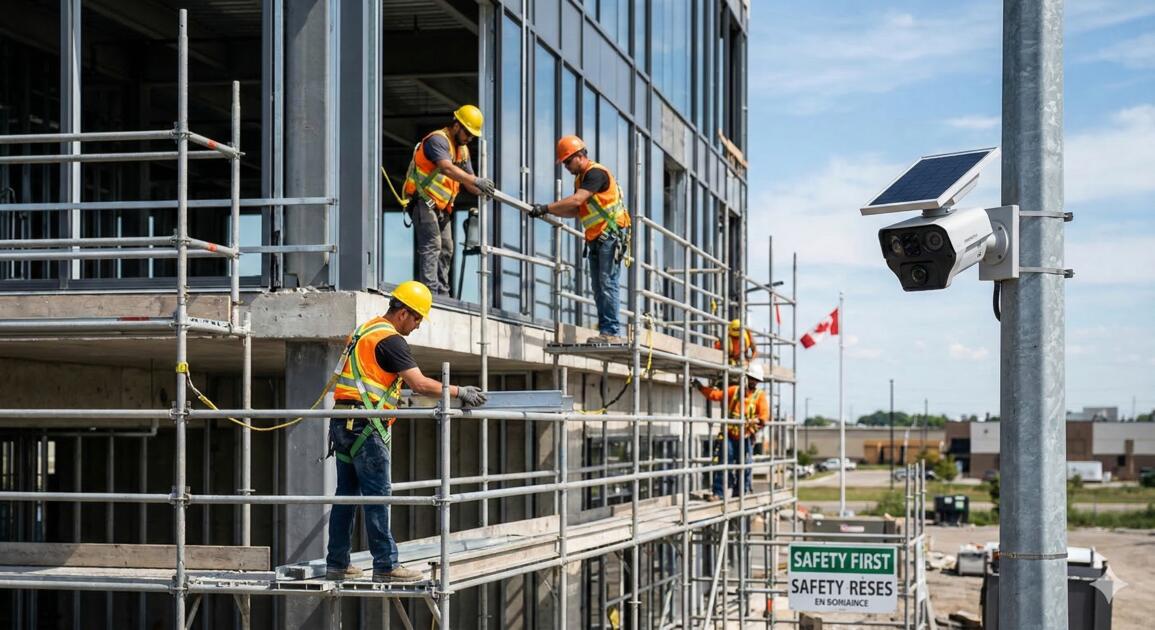
OHSA Compliance on Ontario Construction Sites: Using Cameras to Protect Workers and Your Business
September 15, 2025
Every construction site in Ontario operates under the Occupational Health and Safety Act. There are no exceptions. Whether you are building a single-family home in Mississauga or a transit tunnel under downtown Toronto, the OHSA and its regulations — particularly Ontario Regulation 213/91 for construction projects — define your legal obligations for worker safety.
The penalties for non-compliance are severe. Fines for individuals can reach $100,000 and 12 months in jail. Fines for corporations can reach $1.5 million per offence. Directors and officers can be held personally liable. And beyond the legal exposure, a serious workplace incident can shut down a project, destroy a company’s reputation, and — most importantly — cost someone their life or health.
Compliance is not optional. But meeting OHSA requirements with shrinking supervisory staff and increasingly complex projects is a growing challenge. Construction cameras do not replace safety officers or supervisors. They extend their reach, document compliance continuously, and provide the evidence you need when the Ministry of Labour comes knocking.
What the OHSA Requires on Construction Sites
The Employer’s Duty
Under the OHSA, employers on construction projects must provide information, instruction, and supervision to protect workers. This is a broad obligation that encompasses everything from hazard communication to ensuring that workers use required protective equipment.
The critical word is “supervision.” The Act does not say you need to have a supervisor watching every worker at every moment — that is physically impossible on a busy site. But you must demonstrate that supervision is adequate and that you have systems in place to identify and correct unsafe conditions.
The Supervisor’s Duty
Supervisors — legally defined as anyone who has charge of a workplace or authority over a worker — must ensure that workers comply with the Act and its regulations. They must advise workers of hazards and take every precaution reasonable in the circumstances to protect workers.
When a Ministry of Labour inspector asks a supervisor what precautions were taken, the supervisor who can point to documented evidence — including visual records of safety practices — is in a much stronger position than the one who says “I told them to wear their harnesses.”
Incident Reporting Requirements
Ontario requires employers to report critical injuries and fatalities to the Ministry of Labour immediately by phone, followed by a written report within 48 hours. Non-critical injuries that result in a worker being unable to perform their usual work for more than seven days must also be reported in writing.
The incident report must describe the circumstances of the incident. Camera footage that captured the moments before, during, and after an incident provides an objective record that supplements witness statements and helps investigators determine root causes.
Joint Health and Safety Committees
Construction projects with 20 or more regularly employed workers must have a Joint Health and Safety Committee (JHSC). The JHSC conducts workplace inspections, reviews incident reports, and makes recommendations to the employer. Camera footage can support JHSC inspections by allowing committee members to review conditions across the entire site, not just the areas they physically walk through.
How Cameras Support OHSA Compliance
Documenting PPE Compliance
Personal protective equipment — hard hats, safety boots, high-visibility vests, fall protection harnesses, eye protection, hearing protection — is required on every Ontario construction site. Ensuring that every worker, every subcontractor’s crew, and every visitor complies with PPE requirements is one of the most persistent challenges site supervisors face.
Construction cameras positioned at site entry points and across active work zones capture PPE compliance continuously. While cameras are not a substitute for active supervision, they create a visual record that demonstrates the employer’s commitment to enforcement. If a Ministry of Labour inspector asks whether PPE requirements are consistently enforced, footage showing workers in proper PPE across multiple dates and times is strong supporting evidence.
Fall Protection Monitoring
Falls are the leading cause of workplace fatalities in Ontario construction. Ontario Regulation 213/91 requires fall protection — guardrails, safety nets, or personal fall protection systems — wherever a worker is exposed to a fall of three metres or more.
Cameras covering elevated work areas provide a supplementary monitoring layer. Supervisors can review footage to verify that fall protection systems are in place before, during, and after elevated work. If a worker is observed working without proper fall protection, the footage documents both the violation and the corrective action taken — evidence that is critical in defending due diligence if an incident occurs.
Scaffolding and Formwork Inspections
The construction regulations require scaffolding to be inspected by a competent person before each work shift. Formwork must be designed, erected, and maintained to support all loads to which it will be subjected. Camera footage showing the state of scaffolding and formwork at the start of each day complements written inspection records and provides visual proof that inspections occurred.
Heat Stress and Extreme Weather Monitoring
Ontario’s construction sites face extreme temperature ranges — from minus 30 Celsius in January to plus 35 with humidex in July. The OHSA requires employers to take precautions to protect workers from heat stress and cold stress, including modified work schedules, rest breaks, access to water and shade, and monitoring for symptoms.
Cameras document work activity patterns during extreme weather conditions. If an employer implements a modified work schedule during a heat wave — starting earlier, taking extended breaks during peak heat, stopping work when the humidex exceeds a threshold — camera footage showing reduced or stopped activity during those periods documents compliance.
Remote Supervisor Coverage
The labour shortage is making it harder to maintain adequate supervisory coverage, particularly for companies managing multiple sites. A supervisor who is responsible for two or three projects cannot be physically present at all of them simultaneously.
Live camera feeds allow supervisors to monitor conditions on remote sites between physical visits. This is not a replacement for on-site presence — the OHSA requires supervisors to be competent and present — but it supplements physical visits with continuous visual awareness. A supervisor who reviews camera feeds each morning can identify emerging hazards before arriving on-site and prioritise their inspection route accordingly.
When the Ministry of Labour Inspects
Ministry of Labour inspectors visit Ontario construction sites proactively and in response to complaints, critical injuries, and fatalities. During an inspection, the inspector reviews safety documentation, observes work practices, interviews workers and supervisors, and issues orders for any contraventions identified.
What Inspectors Look For
Inspectors assess whether the employer’s internal responsibility system is functioning — meaning that hazards are identified, communicated, and corrected through the normal course of work. They look for evidence of:
- Worker training and competency documentation
- Workplace inspections and hazard assessments
- Corrective actions taken in response to identified hazards
- PPE availability and enforcement
- Fall protection, scaffolding, and excavation compliance
- Emergency procedures and first aid provisions
How Camera Documentation Helps
Camera footage does not replace the documentation that inspectors expect — training records, inspection logs, JHSC minutes, and incident reports must still exist in written form. But camera footage supplements written records with visual evidence.
When an inspector asks “How do you ensure fall protection compliance on elevated work?” the supervisor who can say “We conduct daily visual inspections, and our camera system captures continuous footage of all elevated work areas, which we review each morning” demonstrates a higher standard of due diligence than the supervisor who says “We tell everyone to wear their harness.”
Building a Due Diligence Defence
If an OHSA charge is laid, the employer’s primary defence is due diligence — demonstrating that the employer took every precaution reasonable in the circumstances to protect workers. This defence requires evidence that systems were in place, that they were followed, and that contraventions were identified and corrected promptly.
Camera footage contributes to due diligence by documenting:
- Consistent enforcement of safety requirements over time (not just on the day of the inspection)
- Prompt corrective action when violations were identified
- Work practices during periods when no supervisor was physically present
- Site conditions before, during, and after incidents
This evidence is difficult to fabricate retroactively. Its contemporaneous and automated nature gives it significant weight in legal proceedings.
Incident Investigation and Root Cause Analysis
When a workplace incident occurs, the employer is legally required to investigate, determine root causes, and implement corrective actions. Camera footage is one of the most valuable tools for incident investigation because it captures what actually happened — not what witnesses remember or believe happened.
Capturing the Moments Before an Incident
Witness accounts of construction incidents are notoriously inconsistent. People under stress recall events differently. Details are forgotten or conflated. Camera footage provides an objective record of the sequence of events leading up to an incident — who was where, what equipment was in use, what conditions existed, and what actions preceded the event.
Supporting Worker Compensation Claims
Camera footage also protects workers. When a worker is injured on-site, footage documenting the incident and the conditions that led to it supports the worker’s compensation claim. This objective record can be particularly important when there is a dispute about the circumstances of an injury.
Reducing Insurance Premiums
Insurance providers increasingly recognise that construction sites with camera monitoring systems present lower risk profiles. Continuous documentation of safety practices, combined with the deterrent effect of visible cameras, contributes to fewer incidents — and insurers reward this with more favourable premium structures.
Practical Implementation
Camera Placement for Safety Monitoring
Position cameras to cover the highest-risk areas on your site:
- Elevated work zones — any area where fall protection is required
- Excavations — trenches, shoring, and access/egress points
- Material hoisting areas — crane operations, material lifts, and laydown areas
- Site entry points — PPE compliance verification
- High-traffic intersections — where pedestrian and equipment paths cross
Integrating Cameras with Your Safety Programme
Camera monitoring should be documented in your site-specific safety plan. Include camera locations, review schedules, footage retention periods, and the process for using footage in incident investigations. This formalises the camera system as part of your internal responsibility system, which strengthens your due diligence position.
Privacy Considerations
Construction cameras on a worksite are generally permissible under Ontario’s privacy framework, as construction sites are not spaces where workers have a reasonable expectation of privacy. However, best practice is to:
- Notify workers during site orientation that cameras are in use
- Explain that cameras are positioned for progress documentation and safety monitoring, not individual surveillance
- Post signage at site entry points
- Limit camera access to authorised personnel
Transparency eliminates concerns and actually improves the cameras’ deterrent effect on unsafe behaviour.
Frequently Asked Questions
Does the OHSA require construction sites to have cameras?
No. The OHSA does not mandate cameras on construction sites. However, the Act requires employers to provide adequate supervision and take every precaution reasonable in the circumstances to protect workers. Cameras are a tool that supports these obligations — they extend supervisory coverage, document compliance, and provide evidence for due diligence.
Can camera footage be used against an employer in an OHSA prosecution?
Yes. If camera footage shows a safety violation that contributed to an incident, it can be used as evidence in a prosecution. However, this works both ways. Footage that shows consistent compliance, active enforcement, and prompt corrective action is far more likely to help the employer’s due diligence defence than to harm it. The employers most at risk are those with no documentation at all.
How long should safety-related camera footage be retained?
For general safety documentation, retain footage for the duration of the project plus the applicable limitation period for OHSA prosecutions (one year from the date of the offence). For footage related to critical injuries or fatalities, retain indefinitely. For footage supporting live monitoring and security, standard project retention periods apply.
Do cameras reduce the need for on-site safety officers?
No. Cameras supplement safety officers but do not replace them. The OHSA requires competent supervisors to be present on construction projects. Cameras extend the reach of those supervisors by providing visual coverage of areas they cannot physically be in at all times. On projects with multiple work fronts, this supplementary coverage is particularly valuable.
OHSA compliance is not a box to check — it is a legal obligation that protects workers and protects your business. Construction cameras make compliance easier to achieve, easier to demonstrate, and easier to defend.